Recursive Methods In Economic Dynamics Pdf Download

A visual form of recursion known as the Droste issue. The adult female in this image holds an object that contains a smaller paradigm of her holding an identical object, which in turn contains a smaller image of herself belongings an identical object, and so forth. 1904 Droste cocoa tin, designed by Jan Misset
Recursion (describing word: recursive) occurs when a matter is defined in terms of itself or of its type. Recursion is used in a multifariousness of disciplines ranging from linguistics to logic. The almost common application of recursion is in mathematics and information science, where a office being defined is applied inside its own definition. While this evidently defines an space number of instances (function values), it is often done in such a way that no infinite loop or infinite chain of references can occur.
Formal definitions

Ouroboros, an ancient symbol depicting a serpent or dragon eating its own tail.
In mathematics and computer scientific discipline, a class of objects or methods exhibits recursive behavior when information technology can exist defined by ii properties:
- A simple base case (or cases) — a terminating scenario that does not utilise recursion to produce an answer
- A recursive step — a set up of rules that reduces all successive cases toward the base of operations case.
For example, the following is a recursive definition of a person's antecedent. Ane's ancestor is either:
- One's parent (base of operations example), or
- 1's parent'due south antecedent (recursive footstep).
The Fibonacci sequence is another classic instance of recursion:
- Fib(0) = 0 every bit base of operations instance 1,
- Fib(one) = 1 as base case two,
- For all integers due north > 1, Fib(due north) = Fib(northward − 1) + Fib(n − two).
Many mathematical axioms are based upon recursive rules. For example, the formal definition of the natural numbers by the Peano axioms tin can exist described every bit: "Nix is a natural number, and each natural number has a successor, which is also a natural number."[1] Past this base instance and recursive dominion, one can generate the set of all natural numbers.
Other recursively defined mathematical objects include factorials, functions (east.grand., recurrence relations), sets (e.chiliad., Cantor ternary ready), and fractals.
There are various more than natural language-in-cheek definitions of recursion; see recursive humour.
Informal definition

Recently refreshed sourdough, bubbling through fermentation: the recipe calls for some sourdough left over from the last time the aforementioned recipe was made.
Recursion is the process a process goes through when 1 of the steps of the procedure involves invoking the procedure itself. A procedure that goes through recursion is said to be 'recursive'.[2]
To understand recursion, one must recognize the distinction between a procedure and the running of a procedure. A procedure is a gear up of steps based on a set of rules, while the running of a process involves really post-obit the rules and performing the steps.
Recursion is related to, simply not the same equally, a reference inside the specification of a procedure to the execution of some other procedure.
When a procedure is defined every bit such, this immediately creates the possibility of an countless loop; recursion tin only be properly used in a definition if the step in question is skipped in certain cases so that the procedure can complete.
But even if information technology is properly defined, a recursive procedure is not easy for humans to perform, as it requires distinguishing the new from the old, partially executed invocation of the procedure; this requires some assistants as to how far various simultaneous instances of the procedures accept progressed. For this reason, recursive definitions are very rare in everyday situations.
In language
Linguist Noam Chomsky, among many others, has argued that the lack of an upper bound on the number of grammatical sentences in a language, and the lack of an upper bound on grammatical judgement length (across practical constraints such as the time available to utter ane), can exist explained equally the consequence of recursion in tongue.[3] [4]
This tin can be understood in terms of a recursive definition of a syntactic category, such as a sentence. A sentence can have a structure in which what follows the verb is another sentence: Dorothy thinks witches are unsafe, in which the judgement witches are dangerous occurs in the larger ane. So a sentence can exist defined recursively (very roughly) as something with a construction that includes a noun phrase, a verb, and optionally another sentence. This is really but a special case of the mathematical definition of recursion.
This provides a way of agreement the creativity of linguistic communication—the unbounded number of grammatical sentences—because it immediately predicts that sentences tin be of arbitrary length: Dorothy thinks that Toto suspects that Tin Human said that.... There are many structures apart from sentences that can be defined recursively, and therefore many ways in which a sentence tin can embed instances of 1 category inside another.[five] Over the years, languages in general have proved amenable to this kind of analysis.
Recently, still, the more often than not accepted idea that recursion is an essential belongings of human linguistic communication has been challenged past Daniel Everett on the basis of his claims about the Pirahã linguistic communication. Andrew Nevins, David Pesetsky and Cilene Rodrigues are among many who take argued against this.[6] Literary self-reference tin in whatsoever example be argued to be different in kind from mathematical or logical recursion.[vii]
Recursion plays a crucial role not merely in syntax, simply also in natural language semantics. The word and, for example, tin can exist construed as a role that can employ to sentence meanings to create new sentences, and likewise for substantive phrase meanings, verb phrase meanings, and others. It tin can also apply to intransitive verbs, transitive verbs, or ditransitive verbs. In club to provide a single denotation for information technology that is suitably flexible, and is typically defined and then that it can take any of these different types of meanings as arguments. This can be washed by defining it for a uncomplicated case in which it combines sentences, and so defining the other cases recursively in terms of the simple ane.[8]
A recursive grammar is a formal grammar that contains recursive production rules.[ix]
Recursive humor

Recursion is sometimes used humorously in computer science, programming, philosophy, or mathematics textbooks, generally by giving a circular definition or self-reference, in which the putative recursive footstep does not go closer to a base of operations case, but instead leads to an infinite regress. It is non unusual for such books to include a joke entry in their glossary along the lines of:
- Recursion, come across Recursion.[ten]
A variation is found on page 269 in the alphabetize of some editions of Brian Kernighan and Dennis Ritchie's book The C Programming Language; the index entry recursively references itself ("recursion 86, 139, 141, 182, 202, 269"). Early on versions of this joke can be constitute in Let's talk Lisp by Laurent Siklóssy (published by Prentice Hall PTR on December 1, 1975, with a copyright date of 1976) and in Software Tools by Kernighan and Plauger (published by Addison-Wesley Professional person on January xi, 1976). The joke also appears in The UNIX Programming Surround by Kernighan and Pike. Information technology did not announced in the commencement edition of The C Programming Linguistic communication. The joke is part of the Functional programming folklore and was already widespread in the functional programming community before the publication of the same books.
Some other joke is that "To understand recursion, yous must sympathize recursion."[x] In the English-linguistic communication version of the Google web search engine, when a search for "recursion" is made, the site suggests "Did y'all hateful: recursion."[11] An culling course is the following, from Andrew Plotkin: "If you already know what recursion is, just remember the answer. Otherwise, observe someone who is standing closer to Douglas Hofstadter than you are; then inquire him or her what recursion is."
Recursive acronyms are other examples of recursive humor. PHP, for example, stands for "PHP Hypertext Preprocessor", Vino stands for "WINE Is Not an Emulator" GNU stands for "GNU's not Unix", and SPARQL denotes the "SPARQL Protocol and RDF Query Language".
In mathematics
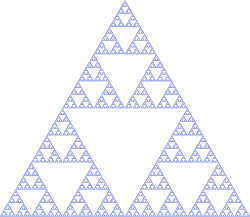
Recursively divers sets
Case: the natural numbers
The approved example of a recursively defined set is given by the natural numbers:
- 0 is in
- if n is in , then n + 1 is in
- The fix of natural numbers is the smallest set satisfying the previous two backdrop.

In mathematical logic, the Peano axioms (or Peano postulates or Dedekind–Peano axioms), are axioms for the natural numbers presented in the 19th century by the German mathematician Richard Dedekind and by the Italian mathematician Giuseppe Peano. The Peano Axioms ascertain the natural numbers referring to a recursive successor part and improver and multiplication equally recursive functions.
Example: Proof procedure
Another interesting instance is the set of all "provable" propositions in an evident system that are defined in terms of a proof procedure which is inductively (or recursively) defined as follows:
- If a suggestion is an precept, it is a provable suggestion.
- If a proposition can be derived from true reachable propositions past means of inference rules, it is a provable proposition.
- The prepare of provable propositions is the smallest set of propositions satisfying these weather condition.
Finite subdivision rules
Finite subdivision rules are a geometric form of recursion, which can be used to create fractal-similar images. A subdivision rule starts with a collection of polygons labelled by finitely many labels, and then each polygon is subdivided into smaller labelled polygons in a way that depends only on the labels of the original polygon. This process can be iterated. The standard `heart thirds' technique for creating the Cantor set is a subdivision rule, equally is barycentric subdivision.
Functional recursion
A function may be recursively defined in terms of itself. A familiar case is the Fibonacci number sequence: F(northward) = F(north − ane) + F(north − 2). For such a definition to be useful, it must be reducible to not-recursively defined values: in this case F(0) = 0 and F(1) = 1.
A famous recursive office is the Ackermann function, which, unlike the Fibonacci sequence, cannot be expressed without recursion.[ citation needed ]
Proofs involving recursive definitions
Applying the standard technique of proof by cases to recursively defined sets or functions, equally in the preceding sections, yields structural consecration — a powerful generalization of mathematical consecration widely used to derive proofs in mathematical logic and information science.
Recursive optimization
Dynamic programming is an approach to optimization that restates a multiperiod or multistep optimization problem in recursive form. The key result in dynamic programming is the Bellman equation, which writes the value of the optimization problem at an before fourth dimension (or before step) in terms of its value at a later time (or later step).
The recursion theorem
In set theory, this is a theorem guaranteeing that recursively defined functions be. Given a set Ten, an element a of X and a function f: X → 10 , the theorem states that at that place is a unique function (where denotes the set of natural numbers including cypher) such that



for any natural number north.
Proof of uniqueness
Take 2 functions and such that:



where a is an element of X.
It can be proved by mathematical induction that F(n) = One thousand(n) for all natural numbers n:
- Base of operations Case: F(0) = a = G(0) and so the equality holds for n = 0.
- Inductive Step: Suppose F(k) = Thousand(k) for some . So F(k + 1) = f(F(k)) = f(G(m)) = G(k + 1).
- Hence F(k) = K(one thousand) implies F(k + one) = G(g + i).

By consecration, F(n) = G(northward) for all .

In information science
A common method of simplification is to divide a problem into subproblems of the aforementioned blazon. Equally a reckoner programming technique, this is chosen split up and conquer and is key to the design of many important algorithms. Separate and conquer serves as a top-down approach to trouble solving, where problems are solved past solving smaller and smaller instances. A contrary approach is dynamic programming. This approach serves every bit a lesser-up approach, where bug are solved by solving larger and larger instances, until the desired size is reached.
A archetype example of recursion is the definition of the factorial function, given here in C code:
unsigned int factorial ( unsigned int north ) { if ( north == 0 ) { return ane ; } else { return northward * factorial ( northward - 1 ); } } The function calls itself recursively on a smaller version of the input (n - 1) and multiplies the effect of the recursive call past due north, until reaching the base case, analogously to the mathematical definition of factorial.
Recursion in estimator programming is exemplified when a role is defined in terms of simpler, oft smaller versions of itself. The solution to the problem is then devised past combining the solutions obtained from the simpler versions of the trouble. One instance application of recursion is in parsers for programming languages. The great advantage of recursion is that an infinite set of possible sentences, designs or other data tin can be defined, parsed or produced by a finite computer program.
Recurrence relations are equations which define one or more sequences recursively. Some specific kinds of recurrence relation tin can exist "solved" to obtain a non-recursive definition (eastward.g., a airtight-course expression).
Use of recursion in an algorithm has both advantages and disadvantages. The main advantage is usually the simplicity of instructions. The main disadvantage is that the memory usage of recursive algorithms may grow very quickly, rendering them impractical for larger instances.
In biology
Shapes that seem to take been created by recursive processes sometimes announced in plants and animals, such as in branching structures in which 1 large function branches out into two or more like smaller parts. Ane example is Romanesco broccoli.[12]
In art
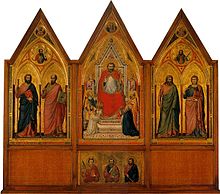
Front face of Giotto'due south Stefaneschi Triptych, 1320, recursively contains an image of itself (held upwards by the kneeling figure in the central console).
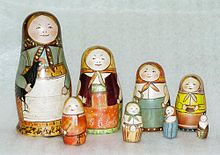
The Russian Doll or Matryoshka doll is a concrete creative example of the recursive concept.[13]
Recursion has been used in paintings since Giotto's Stefaneschi Triptych, made in 1320. Its key console contains the kneeling effigy of Cardinal Stefaneschi, holding upward the triptych itself as an offering.[14] [ failed verification ]
M. C. Escher's Print Gallery (1956) is a print which depicts a distorted city containing a gallery which recursively contains the motion picture, and and so advertising infinitum.[15]
Run across also
- Corecursion
- Course-of-values recursion
- Digital infinity
- A Dream Inside a Dream (poem)
- Droste outcome
- False enkindling
- Fixed signal combinator
- Space compositions of analytic functions
- Infinite loop
- Infinite regress
- Infinitism
- Infinity mirror
- Iterated function
- Mathematical induction
- Mise en abyme
- Reentrant (subroutine)
- Self-reference
- Spiegel im Spiegel
- Foreign loop
- Tail recursion
- Tupper'south self-referential formula
- Turtles all the way downward
References
- ^ "Peano axioms | mathematics". Encyclopedia Britannica . Retrieved 2019-10-24 .
- ^ "Definition of RECURSIVE". www.merriam-webster.com . Retrieved 2019-10-24 .
- ^ Pinker, Steven (1994). The Language Instinct. William Morrow.
- ^ Pinker, Steven; Jackendoff, Ray (2005). "The faculty of linguistic communication: What's so special well-nigh it?". Cognition. 95 (ii): 201–236. CiteSeerXten.ane.1.116.7784. doi:x.1016/j.cognition.2004.08.004. PMID 15694646. S2CID 1599505.
- ^ Nordquist, Richard. "What Is Recursion in English language Grammar?". ThoughtCo . Retrieved 2019-10-24 .
- ^ Nevins, Andrew; Pesetsky, David; Rodrigues, Cilene (2009). "Bear witness and argumentation: A answer to Everett (2009)" (PDF). Language. 85 (3): 671–681. doi:10.1353/lan.0.0140. S2CID 16915455. Archived from the original (PDF) on 2012-01-06.
- ^ Drucker, Thomas (4 January 2008). Perspectives on the History of Mathematical Logic. Springer Scientific discipline & Concern Media. p. 110. ISBN978-0-8176-4768-ane.
- ^ Barbara Partee and Mats Rooth. 1983. In Rainer Bäuerle et al., Meaning, Use, and Interpretation of Language. Reprinted in Paul Portner and Barbara Partee, eds. 2002. Formal Semantics: The Essential Readings. Blackwell.
- ^ Nederhof, Marking-Jan; Satta, Giorgio (2002), "Parsing Non-recursive Context-free Grammars", Proceedings of the 40th Almanac Meeting on Association for Computational Linguistics (ACL '02), Stroudsburg, PA, United states of america: Clan for Computational Linguistics, pp. 112–119, doi:x.3115/1073083.1073104 .
- ^ a b Hunter, David (2011). Essentials of Discrete Mathematics. Jones and Bartlett. p. 494. ISBN9781449604424.
- ^ "recursion - Google Search". www.google.com . Retrieved 2019-10-24 .
- ^ "Picture of the Day: Fractal Cauliflower". 28 December 2012. Retrieved 19 April 2020.
- ^ Tang, Daisy. "Recursion". Retrieved 24 September 2015.
More examples of recursion: Russian Matryoshka dolls. Each doll is made of solid wood or is hollow and contains some other Matryoshka doll inside it.
- ^ "Giotto di Bondone and assistants: Stefaneschi triptych". The Vatican. Retrieved 16 September 2015.
- ^ Cooper, Jonathan (5 September 2007). "Art and Mathematics". Retrieved five July 2020.
Bibliography
- Dijkstra, Edsger W. (1960). "Recursive Programming". Numerische Mathematik. ii (ane): 312–318. doi:10.1007/BF01386232. S2CID 127891023.
- Johnsonbaugh, Richard (2004). Discrete Mathematics. Prentice Hall. ISBN978-0-13-117686-7.
- Hofstadter, Douglas (1999). Gödel, Escher, Bach: an Eternal Golden Complect. Basic Books. ISBN978-0-465-02656-2.
- Shoenfield, Joseph R. (2000). Recursion Theory . A One thousand Peters Ltd. ISBN978-one-56881-149-9.
- Causey, Robert L. (2001). Logic, Sets, and Recursion . Jones & Bartlett. ISBN978-0-7637-1695-0.
- Cori, Rene; Lascar, Daniel; Pelletier, Donald H. (2001). Recursion Theory, Gödel's Theorems, Set Theory, Model Theory. Oxford University Printing. ISBN978-0-19-850050-vi.
- Barwise, Jon; Moss, Lawrence S. (1996). Vicious Circles. Stanford Univ Center for the Study of Language and Information. ISBN978-0-nineteen-850050-6. - offers a treatment of corecursion.
- Rosen, Kenneth H. (2002). Detached Mathematics and Its Applications. McGraw-Hill Higher. ISBN978-0-07-293033-7.
- Cormen, Thomas H.; Leiserson, Charles E.; Rivest, Ronald Fifty.; Stein, Clifford (2001). Introduction to Algorithms. Mit Pr. ISBN978-0-262-03293-3.
- Kernighan, B.; Ritchie, D. (1988). The C programming Linguistic communication. Prentice Hall. ISBN978-0-xiii-110362-7.
- Stokey, Nancy; Robert Lucas; Edward Prescott (1989). Recursive Methods in Economic Dynamics. Harvard University Press. ISBN978-0-674-75096-8.
- Hungerford (1980). Algebra. Springer. ISBN978-0-387-90518-1. , first chapter on set theory.
External links
- Recursion - tutorial by Alan Gauld
- Zero Files All The Way Down
- Nevins, Andrew and David Pesetsky and Cilene Rodrigues. Bear witness and Argumentation: A Respond to Everett (2009). Language 85.iii: 671--681 (2009)
DOWNLOAD HERE
Posted by: mcmillanwasel1988.blogspot.com
Post a Comment